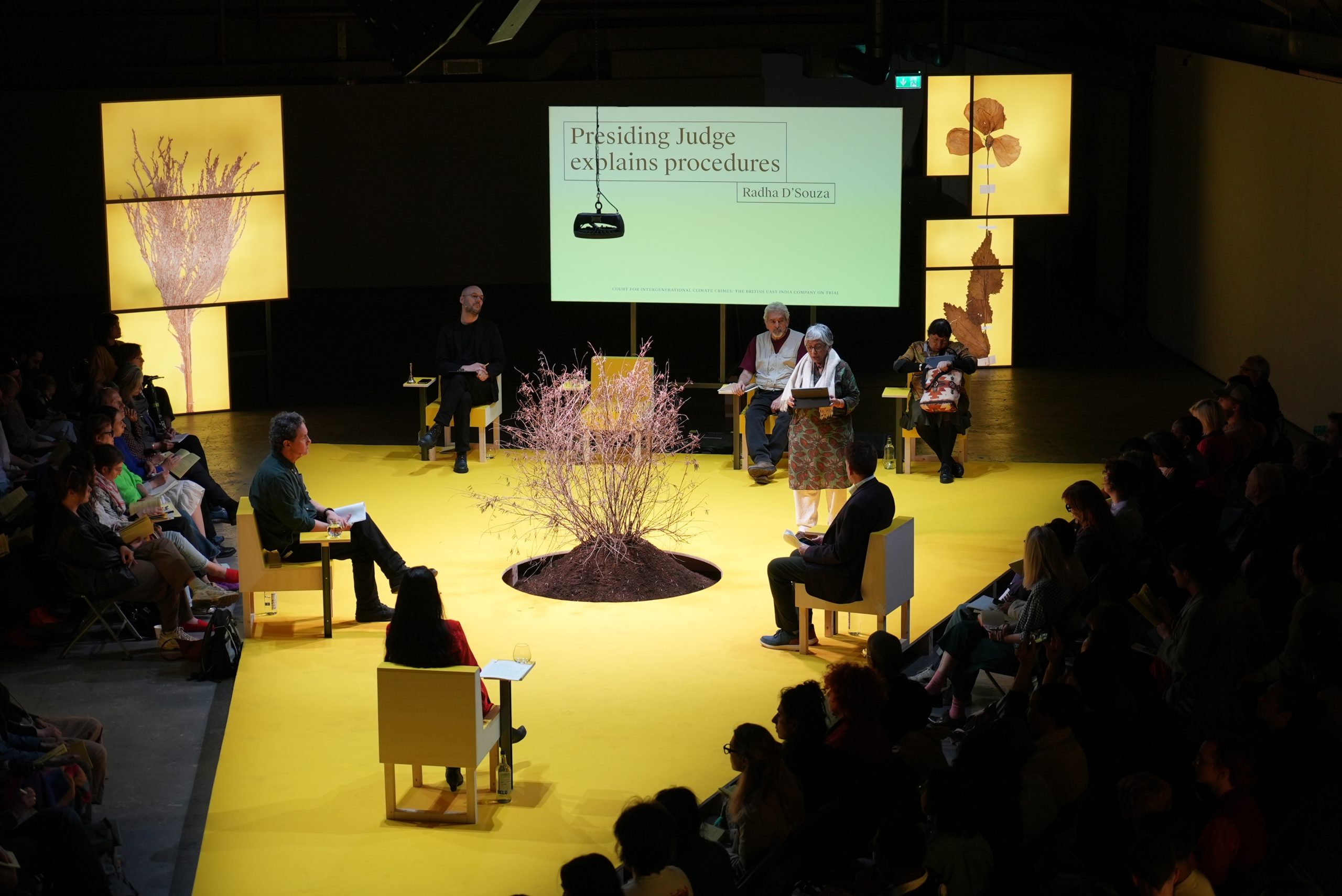
This special dossier of Hyphen Journal comprises an assemblage of records, reflections, conversations, intersections, openings and departures that are in dialogue with the London iteration of the Court for Intergenerational Climate Crimes (CICC), a project by legal scholar and activist Radha D’Souza and artist Jonas Staal. Titled The British East India Company on Trial, the CICC sat for three hearings at Ambika P3 in April 2025, followed by a three-week programme of talks, discussions, screenings, workshops, performances and walking tours, titled the CICC School. The contributions gathered here are in dialogue with various aspects of this programme of activities and have been created by a group of correspondents made up of PhD candidates at CREAM and other research departments at the University of Westminster, visiting researchers, as well as critical friends from further afield. Much like the sessions of the court invited everyone in attendance to be an active participant as a member of the Public Jury, and the CICC School transformed the court’s setting into a lively space for encounters, collective deliberation and shared learning, this special dossier approaches the CICC as a generative proposition, one that allows for urgent questions to be addressed, about intergenerational and interspecies justice, about the long reverberations and continuations of colonial violence, and about modes of togetherness and resistance that can prefigure alternative, non-extractive futures.
As a point of departure, Pedro Urano’s ‘The leaves are coming out’ relates a brief poetic encounter with the indigo plant growing at the centre of the CICC’s court for the duration of the project. Referred to throughout proceedings as Comrade Indigo, the plant’s presence as a more-than-human witness is a topic that several contributors to this issue address. This is the case with Natalie Kynigopoulou’s account of Case I of the CICC, ‘Entangled Futures- Revolving Celluloses and Seeds of Hope’, in which the indigo plant sprouts seeds of hope for rooted, symbiotic, entangled futures. The text also reflects on the East India Company’s role in instigating long histories of corporate-state collusion that continue to this day, as well as the role of the Public Jury in the CICC as a form of communitarian assembly.
Geyujing Shen’s, ‘Ain’t I a plant? Ain’t I a Woman?—A Reflective Journey Through Case II of the CICC’ addresses the ghostly atmosphere of Ambika P3, which used to be a concrete testing facility before being repurposed as an exhibition space, and in whose industrial surroundings the Witnesses and Advocate for Case II highlighted continuities between socio-ecological destruction from the East India Company (EIC) to contemporary agribusiness in Africa. With the EIC’s indigo trade providing a central point of departure for Case II, Shen again reflects on the presence of the plant at the centre of the court, in this case with a view to feminist notions of embodiment and selfhood. HC Krempels, in ‘Indigo Witness: Gathering Around those Others Not Human’ continues the encounter with Case II as well as Comrade Indigo, particularly mobilising a discussion of animism in order to ask how the voices of ‘earth others’ can be addressed in meaningful ways in a space such as the CICC. Krempels also speaks to Rachel Pimm, the artist and botanist who sourced and cared for the indigo, and whose prosecution for direct action against the production of weapons for the Palestinian genocide raises difficult questions around the performativity of legal structures. Finally, the text visits two CICC School events – Dub Indigo Resistances and Unsensed: More Than Human Rights, and reflects on Krempels’ own drawing practice as a method for interpreting the negotiations between human participants and the indigo plant during the CICC.
The CICC was also visited by a group of Students and Professors of Scenography & Exhibition Design at Karlsruhe University of Arts and Design, whose ‘A Fragmented Documentation of the Court for Intergenerational Climate Crimes’ lives and proliferate on a separate website, which opens up perspectives on the spatial, content-related, and temporal structures of the three CICC London cases. A multi-layered and polyphonic collection of reports, notes, drawings, comments and an interview with Radha D’Souza provide an experiential rendering of the complexity of this event.
A further interview with Radha D’Souza by Pedro Urano discusses the CICC’s conceptual framework, the project’s various iterations to date, the role of the Public Jury, as well as themes such as the notion of putting the law itself on trial – one of the motivations underpinning the CICC’s activities – and the notion of reparations as systemic transformation. Urano also contributes an interview with Ramón Vera-Herrera, who, besides being one of the CICC’s judges, contributed a talk titled Territory as a place of encounter and meaning to the CICC School. The conversation engages with some of the images that animated Vera-Herrera’s talk, before addressing the situation of Indigenous people in Mexico, as well as Indigenous practices of autonomy and reciprocal nurturing that extends to all existence.
Reflection on the CICC School continues with Tamsin Green and Susan Ribeiro’s ‘Ingrid Pollard and Corinne Fowler: Under the Indigo Tree: Country Walks and the Colonial Countryside’, which weaves a conversation featuring Pollard and Fowler, titled Colonial Countryside, Empire, Country Houses and Landscape, together with poetic fragments and images, allowing the discussion to echo through the authors’ own diaspora identity and interest in more-than-human ecologies. Intersections between colonialism, place and ecology also play out in Songwon Han’s ‘Processing Trauma by Moving Image: A Reflection on three CICC School Screening Events’, which reads the screenings of the documentaries Legend of the Loom and Bengal Shadows, as well the artist film programme The World’s Womb through trauma theory, highlighting how films as well as the the act of gathering to watch and discuss them can create spaces for witnessing, transmission, remembering and resistance to historical erasure.
Sumita Singha, in her piece ‘The Etonian, the Indians and the Poly boys’ addresses a particular historical blind spot related to the University of Westminster, where Hyphen Journal has its home. With reference to the panel Indian Indenture: Histories, Continuities, Singha recalls how the Victorian tea merchant and philanthropist Quintin Hogg founded the Regent Street Polytechnic that later became the University of Westminster, with profits from indentured labour. With debates on the exploitative histories of indenture as well as the specific diasporic communities that it gave rise to still limited, Singha calls for more discussion on the topic. Soh Kay Min and Kin Chui’s engagement with violent colonial histories takes the form of a game. Inspired by CICC School East India Company Walking Tours at St. Paul’s Cathedral and the East India Docks, Haunting of the East India Company is a mauseological experience, in which players encounter grotesque digital renders of historical artworks, artefacts and monuments in the labyrinthine underground crypt of St. Paul’s Cathedral. Haunting of the East India Company envisages history as a recursive system that repeats, mutates and persists in the infrastructures of the present.
Geuyjing Shen’s final two contributions respond to two workshops held as part of the CICC School. ‘Reflective Journey of the Imagining Otherwise: Decolonial Study Group Workshop’ discusses an event that combined a film screening, discussion groups and a role-playing game, to address issues such as the decolonial potential of water as a carrier of histories and memory, the negotiations and conflicts between the interests of indigenous populations and settlers, and the importance of staying alert to positionality. ‘Cut, tear, draw, compose, stick: Zine-making as a decolonial initiative’ is an account of the workshop How Did We Get Here? Zine Making with Incidental Unit that approaches the possibilities for working with non-linear narrative which zine-making affords as a possible route for articulating the complex navigations and fractures of queer migrant identity, and their wider political significance.
Full recordings of the three London cases are available here. The full CICC School programme is available here.
The Court for Intergenerational Climate Crimes (CICC): The British East India Company on Trial was made possible through a collaboration between CREAM, the Law, Development and Conflict Research Group, the Serpentine and Framer Framed.
Editor-in-Chief: Matthias Kispert
Editorial collective: Tamsin Green, Songwon Han, Frankie Hines, Arne Sjögren