
A discussion with Ingrid Pollard, artist and photographer, and Prof. Corinne Fowler, Professor of Colonialism and Heritage at the University of Leicester.
This discussion, titled Colonial Countryside, Empire, Country Houses and Landscape, was organised as part of the CICC School programme, which inhabited the space of the Court for Intergenerational Climate Crimes in the weeks following the court’s London hearings at Ambika P3. Ingrid and Corinne considered their work in response to the British countryside’s colonial connections. This includes their collaboration on the child-led history and writing project, Colonial Countryside, which ran between 2018 and 2022, as well as their Opium Walk through Wordsworth’s Lake District, which is also featured in Corrine’s latest book, Our Island Stories: Country Walks through Colonial Britain (2025).
Two lens-based artists and doctoral researchers met over a shared question: What happens when a historian and an artist walk together through a place shaped by empire? Susan Ribeiro explores her second-generation Pan-Iberian diaspora identity, shaped by a personal family archive of migration and inherited memory; and Tamsin Green explores more-than-human ecologies through the embodied processes of walking and publishing.
We were invited to think together in response to Corinne and Ingrid’s conversation. What follows is not a transcript, it’s an echo of the discussion that unfolded at Ambika P3 between us, a layering of voices: theirs with ours; part memory, part response, part imagination.
—
Susan Ribeiro:
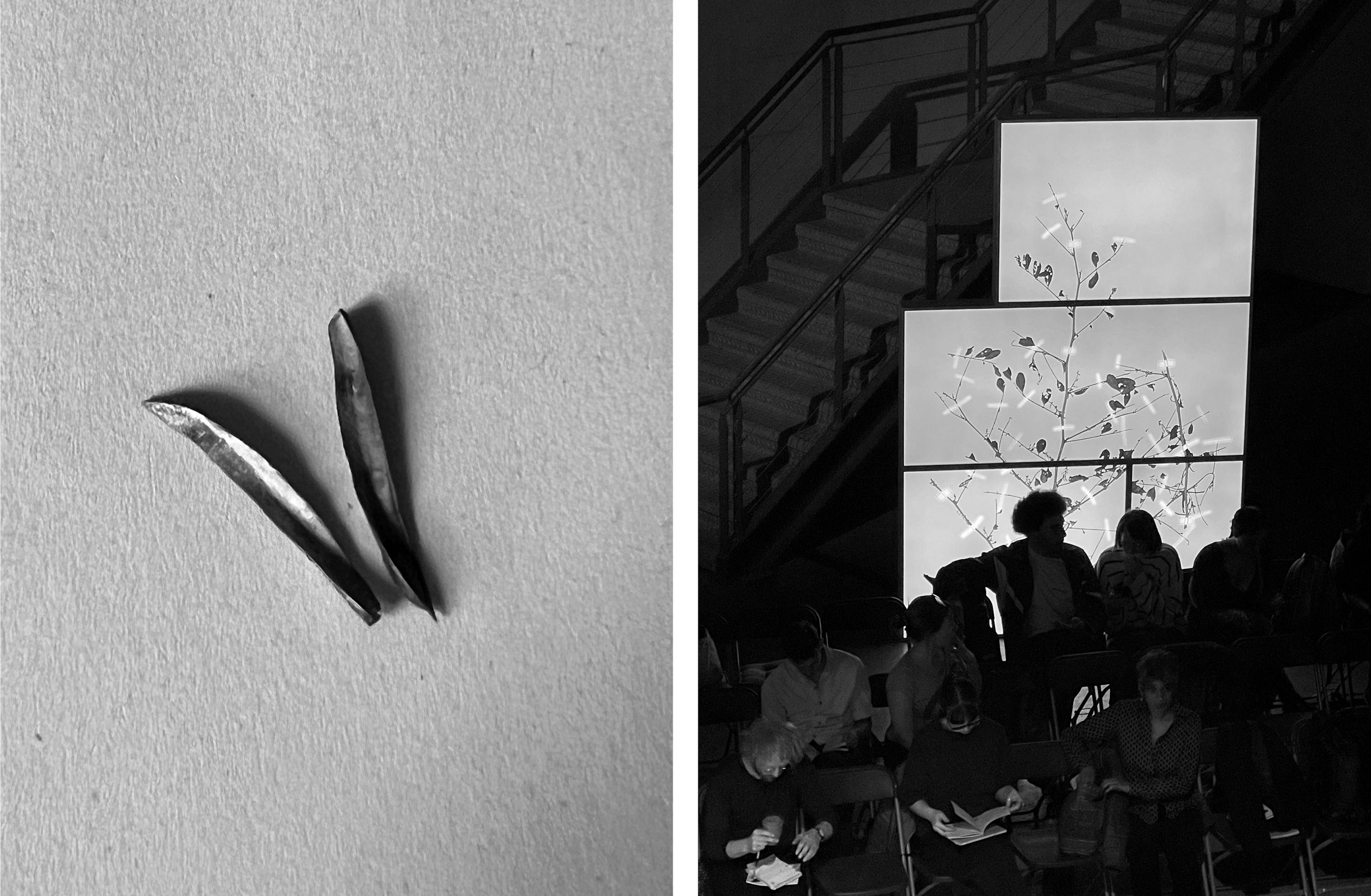
We gathered beneath the Indigo Tree.
made of multiple small leaves arranged along central stalks.
A provider of shade and shelter,
a witness with roots that keeps asking to be heard.
The tree held the space between us,
not dividing,
but anchoring.
A keeper of things.
A centre we all leaned toward.
Tamsin Green:
questions lingered
who owns the land?
who owns the seeds?
who decides what is planted?
who decides where?
Cotton
Nutmeg
Tobacco
Indigo
comrades unearthed, categorised and transplanted
witnesses in our archives, place names and map language
we are present
and an opening has been created
Ingrid Pollard: On the train up I was thinking about the way I investigate particular people within the social landscape, or my relationship with particular landscapes, places or documentation. Originally, if I went to a site, I would go to the marriage, births and deaths office and look through the last 300 years. How they documented, how they described people of colour in that particular area. It may be very hidden but it is hidden in plain sight. Now my approach is about looking at particular individuals associated, whether it’s Lord Lowther or Wordsworth or someone like that, who becomes a way of talking about the English landscape and those landscapes are defined through those writers or painters, so it’s challenging those. It is looking at who is there and who is not there and how they are described and classified.
Corinne Fowler: I’m from Birmingham, and my parents used to take me walking at the weekend no matter the weather, and so I have a love-hate relationship with the countryside. But I never felt like I didn’t belong there, no one ever asked me why I was there. And you don’t see the things that you don’t experience personally. In terms of ways of working, for me walking through the landscape is really important as it grounds me in the history, and there are certain things that you get from walking through a landscape that you cannot get from an archive. I have gone from very little awareness of colonial history and landscapes to a much greater knowledge and understanding of the fact that you could virtually put a pin in any part of a map of Britain and you could find an amazing colonial connection, or historical Black presence, or some kind of link. It is always there, and like you say Ingrid, you do not have to look that hard.
Ingrid and Corinne
two people familiar
with the deep terrains
of British history.
Talking not presenting,
remembering,
theorising,
gossiping.
Sharing stories that begin
somewhere in an archive
and end up
in the soles of their shoes.
where one body
one record
one specimen
all stand in for many
Corinne Fowler: One of the other East India Company properties we went to that was probably one of the most knowable was Kedleston Hall. It belonged to Curzon’s family, Curzon being the Viceroy of India. That hall has a replica in India, Calcutta.
Ingrid Pollard: There is just so much of everything. I found it unpleasant being there because it’s about wealth and gaining. And having lots of things with no sense of responsibility for what that means, even now.
Corinne Fowler: All the references to the objects were written in turn-of-the-century labels. So there was one label, the ivory elephant, it’s a really delicate and beautiful thing. But all the ivory objects are arranged together, so all the objects are put completely out of context, and they’re put together aesthetically and by material, not through any historical context at all. I remember one time, there was a visitor of Indian heritage who saw some of the objects and cried because the object meant so much to him. But he was also upset by the way they were labelled.
Ingrid Pollard: There was one house we went to, and there were Indian sisters who lived there. We were asking the volunteers: do you have any information? They said, no, there’s nothing there. We just opened a drawer, and it had loads of newspapers about these sisters. Just in this drawer. So again, it’s in plain sight, if you want to look for it.
Somewhere in their speaking,
I began to hear my own,
not in the words exactly, but in the edges of what was said.
A low frequency, older than language.
when walking with images and words
sometimes they float by
and sometimes they engulf like clouds
Corinne and Ingrid have been such companions
asking questions of the land
asking questions of what we do not see
time and space collapse and expand
as an altered landscape enters the frame
I study what is passed down,
between mothers and daughters.
It’s what lingers between cultures, between generations.
In the photos not framed,
in the names mispronounced
and left that way.
My mother, a foreigner to these shores.
Taught me how to listen, how to read.
To trace the absences history forgets to mention,
and speak of its quietness.
Ingrid Pollard: I think it was in Whitehaven, on the west coast of Cumbria to the Lake District and looking out to the Atlantic. it was one of those times I was looking through birth, marriage and death records, and I could trace this man and woman and they had two children, and the day they came to all get baptised, I looked at the list and there were loads of, I presume Africans, all getting baptised on the same day. And I thought, what’s the story? This is really interesting. Do they know each other? What’s happening here?
Corinne Fowler: Whitehaven is a really interesting example, because it was a major port, even though it’s a small place now, with a few seagulls and chip papers flying around the streets. It turns out that local archivists, when they looked at the parish records, saw that the place was more multicultural in the past than it is today, as it is with so many rural places nowadays. Also, there were so many records that it takes pages and pages to actually fit them all on. And that’s because, on the one hand, there would be transatlantic ships going out on those tobacco runs. And on the other hand, there was a massive East India Company history. And that part of the Whitehaven Coast belongs to the National Trust, whose website says that it’s the story of coal, but it’s not. It’s the story of coal, tobacco and East India Company ships. If you look at that harbour today, and I recommend the walk along the coast, don’t do it on a windy day, because you would literally be blown into the sea. But on a calm day, walk along that coast, and when you get to the harbour, you can see that there are two parts. There’s the near part of the harbour, which is for shallow-bottomed coal ships, and then the deep part of the harbour is for transatlantic ships, which were deep-bottomed. So, even the harbour tells that story today, and all of the Georgian houses and some of the other buildings, which were paid for with the East India Company and/or tobacco wealth. So that is a very rich area. Anything west coast, anything facing the Atlantic along that west coast, has always got something interesting to reveal.
We were here to listen to a different kind of trial.
The East India Company called to account,
not just for what it did,
but for how it still lives.
In street corners and pub names,
in museum cabinets and family collections,
in imported plants and trees.
In people who inherited rather than chose to carry its legacy,
in land,
and stolen time.
we weren’t searching for a single reading
where bodies, seeds, soil are connected
multiple paths reveal the rearranging of worlds
a temporality that spirals
ecologies shifting and transforming
I gathered beneath the Indigo Tree.
But now,
I speak like one.
Low,
Rooted,
Still.
Like the pollination of dreams,
held by the landscape.
These histories do not rest,
they wait to be walked.
—–
The conversation Under the Indigo Tree is a story rooted in soil and memory. For those who want to walk further with these ideas, here are some texts, projects and voices to accompany you.
Fowler, Corinne (2020), Green Unpleasant Land: Creative Responses to Rural England’s Colonial Connections, Peepal Tree Press.
Fowler, Corinne (2024), Our Island Stories: Country Walks through Colonial Britain, London: Allen Lane.
You can also listen to the EMPIRE LINES x Invasion Ecology Spotify playlist for the following episodes:
Fowler, Corinne, with Ingrid Pollard (2024), ‘Our Island Stories: Ten Walks Through Rural Britain and Its Hidden History of Empire’, EMPIRE LINES Live at Invasion Ecology.
Pollar, Ingrid (2022), ‘Carbon Slowly Turning’, EMPIRE LINES x Invasion Ecology.
Or watch here to join Corinne Fowler and Ingrid Pollard in conversation with Invasion Ecology co-curator Jelena Sofronijevic on Vimeo, as they reflect on how colonial histories continue to inform the British countryside.
Watch here to join Corinne Fowler in Walking Through Countryside’s Forgotten Colonial Histories, part of The National Archives series ‘Methodologies: Creative responses and research methods in archives’.