
The first hearing of the Court for Intergenerational Climate Crimes (CICC) in London traces the rule of the British East India Company and the British Crown in South Asia and beyond, highlighting how the policies and practices of this alliance endure in contemporary corporate-state partnerships, and exposing the deep entanglements between colonial legacies, environmental devastation and social harm. The setting is ceremonial as well as pedagogical: we are attuned to the court as a staged scenario presenting a plausible trial, while simultaneously learning of colonial crimes and their ongoing consequences. At the same time, an indigo plant, placed at the very centre of the court, seemingly gestures toward a different present/future, one characterised by entangled relations among humans and nonhumans, one that the court itself begins to make tangible.
Jonas Staal, serving as clerk, opens by declaring the court in session. The court itself is presided over by Comrades Professor Radha D’Souza and Judges Sharon H. Venne and Ramón Vera-Herrera, all of whom intervene with questions at the end of each witness testimony, followed by audience questions. As the first court session commences, 167 years after British East India Company’s dissolution, D’Souza steps forward to lay out the grounds for this case and the questions that will be addressed during this session. ‘Is it true’, D’Souza asks in her opening statement, ‘that the British East India Company and the British Crown together innovated a unique mechanism to govern ecologies and communities across the colonies? Is it true that although the British East India Company is long gone, the systems of governance it established, together with the Crown, have not only survived but continued to expand and flourish?’
She then invites us, the people seated around the court installation and listening to this introduction, to turn our attention to two key documents to read closely, that is the Intergenerational Climate Crimes Act (D’Souza and Staal 2021), found on pp. 21–27 of the court booklet distributed upon entry, and the Statutes of the Special Court on Intergenerational Climate Crimes (D’Souza et al. 2025), located on pp. 29–34.1
At this point, we are invited not to simply observe the tribunal unfold as passive onlookers, but to engage with it as active participants and members of the Public Jury of, as D’Souza names it, this Special Court. She continues, ‘We are present here, not as representatives of personal interests, communities or nations, but as ancestors for future generations – generations, that embody the delicate, interdependent relationships between people, communities and all other beings; relationships essential for all life on this planet to continue’. She carries on, ‘The Act does not privilege human life over non-human life or vice versa. Please keep that in mind. All lives have value, whatever their forms. It is also equally important that you leave the jargon you have learned or heard outside this Special Court and refer only to the Intergenerational Climate Crimes Act 2021 for the meanings and definitions of words and terminology’.
—
As the tribunal proceeds, listening intently to the testimonies of enduring corporate-state alliances that continue to exploit communities and ecologies alike, my attention is drawn to the indigo plant, placed at the very centre of the court, encircled by its comrades, cotton, opium, jute, sugarcane and indigo itself. Archival images of these crops, held together with wire and tape, face the court from illuminated panels positioned around the periphery, emanating a strong yellow light. The courtroom itself is not arranged in a conventional manner. Instead, the installation is conceived as a non-hierarchical, fluid space where constructed elements, including raised wooden platforms as well as the display panels themselves, are arranged in concentric circles rather than rows, evoking ecological entanglements rather than legal formalities. The exchange between the Judges, the Witnesses, and their openness to the audience suggests mutual attentiveness; the Judges invite one another to contribute, witnesses are given equal time to speak and audience members – the Public Jury – are invited to pose their own questions at the conclusion of each statement. In this space, Judges and audience share a rhythm of collaborative engagement rather than a hierarchy of authority. Meanwhile, as a member of the Public Jury I am held in a tension between performance and the social reality of the court setting itself, attuned to the rituals of language, the choreography of the Judges, Witnesses and Advocate standing and sitting at appropriate moments, the careful cadence of courtroom speech, as much as to the gravity of words being spoken.

Witness one, historian James Vaughn, opens the tribunal by challenging what he describes as a conventional myth, that the East India Company was a private enterprise, later to be replaced by the British Crown. Instead, he reveals that from its inception, it functioned as a public-private entity empowered by royal charter to wage war, collect taxes and govern. This extractive partnership, illustratively underscored by examples such as that of Robert Clive, laid the groundwork for an imperial system that funnelled wealth from local populations across South Asia to British elites, leaving behind a legacy of deep, intergenerational ecological and social harm. Clive, a military commander of the East India Company who gained fame for campaigns against European and South Asian forces – and whose bronze statue still stands at the heart of government, on King Charles Street in Whitehall, between the Foreign Office and the Treasury – emerges as a symbolic predecessor of what came after him; an embodiment of the Company’s triumph and the violence that secured it.

Clive, as Vaughn explains, with the full backing of the Company’s shareholders, the British government, and the Crown, secured the Diwani, that is, the right to collect revenue from Bengal, Bihar and Orissa, bringing tens of millions of peasants under direct taxation by the East India Company. This marked a significant moment in history, establishing a system of imperial extraction that consolidated the Company’s political and economic power in South Asia while reinforcing the public-private partnership between the British Crown, the government and the Company itself.
Witness two, investigative journalist Andy Rowell, traces the British East India Company’s legacy through a chain of corporate actors across different historical periods, from the Royal African Company via the Royal Niger Company to Shell, BP and Unilever, highlighting how government officials frequently crossed into corporate leadership and continue to do so. He argues that the extractive colonial model that the East India Company inaugurated never ended – it was absorbed and perpetuated. Today’s multinational corporations, he shows, continue to operate with impunity, using tax avoidance, manipulative publicity and legal loopholes to evade responsibility for environmental and human rights abuses. As one of a few examples, he points to Dove, a Unilever brand that promotes messages of care and empowerment, even as it remains embedded in the same exploitative global corporate machinery that traces its lineage back to imperial times. Rowell’s words reverberate with those of D’Souza, reminding us, the public jury, that we are not neutral spectators. These structures are not abstract or distant, he shows, we live inside them. We consume these corporations’ products, internalise their narratives and move through systems shaped by their logics.

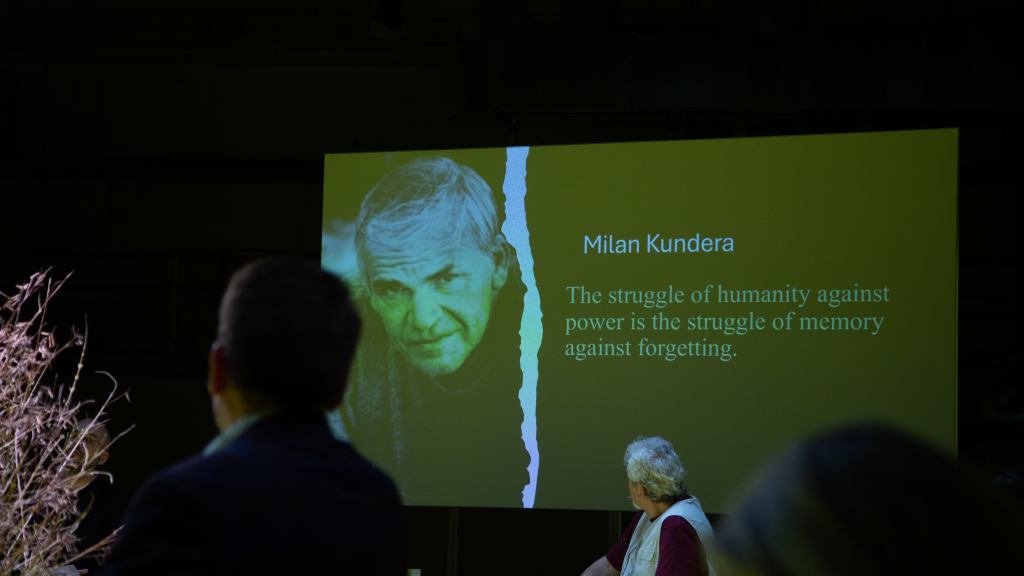
But Rowell’s testimony is also invitational. In invoking the Movement for the Survival of the Ogoni People (MOSOP) and their struggle against Shell to reclaim their land – including the Ogoni Nine, a group that included writer and activist Ken Saro-Wiwa, who were executed by the Nigerian military regime in 1995 for their outspoken opposition to Shell’s operations – Rowell invites us to join a transnational movement demanding justice, accountability and repair; if only by choosing to remember the histories of harm and the people affected. His words echo those of author Milan Kundera (1996:4), ‘[t]he struggle of [humanity] against power is the struggle of memory against forgetting’ – to remember, then, is to resist – before passing the responsibility to us, the jury, with the words: ‘I’ll now allow this room to continue the struggle for justice’.
The Advocate for the Court, political scientist Swati Srivastava, does not simply outline the testimonies that precede her, but names and maps the enduring architecture of impunity that allows extractive violence to persist. The British East India Company, as Srivastava shows, pioneered a hybrid form of corporate-state partnership, one that blurred the boundaries between public and private power. This corporate-state partnership was fed through royal charters and continued through lobbying networks and secrecy structures, through which the British East India Company was able to influence legislation, consolidate power and evade responsibility for harms made. In fact, Srivastava insists, the East India Company may well have been the inventor of modern corporate lobbying. Its inaugural lobbying initiative can be traced to 1698, when it established a parliamentary pressure committee encouraging shareholders to use their positions in Parliament to block legislation that was unfavourable to the Company – such as proposals to ban Indian cloth imports, following mass protests in which 5,000 weavers marched on Parliament. These strategies and networks of corporate state power, far from disappearing with the Company’s dissolution in 1858, were absorbed into subsequent governmental and corporate structures, replicated and refined. Today, Srivastava argues, they live on in the infrastructures of modern capitalism – in the legal personhood of corporations, in the ‘revolving door’ between government and industry, in the shadowy entanglements of law, finance and trade.

Yet Srivastava’s testimony does not simply describe continuity, it denunciates the system itself – and so she closes the session with a critical encounter, with history, with ourselves and with the law itself. The structures that she calls ‘shadow relations’ obscure how public and private power truly function, and this opacity, she insists, is precisely why the law itself is on trial here today. As the audience questions conclude, D’Souza steps forward to extend this point: ‘It is the law itself that is on trial here, for it is the law that enables generation after generation to reproduce the very figures who perpetuate these practices of corporate-state entanglements’. Meanwhile, D’Souza reminds us, echoing her introduction in this Special Court, all humans and nonhumans, that is all subjects of life, are subjects of law and therefore beneficiaries of the law put forward by the Intergenerational Climate Crimes Act. ‘We do not make distinctions to privilege nonhuman lives over human lives or vice versa’, she insists, urging us to rethink the very architecture of law itself, not only in terms of what it allows to pass unchecked, but also in terms of whom it leaves outside its framing altogether.
As today’s trial begins to conclude, my attention drifts once more to the indigo plant at the centre of the court, its presence lingering among the testimonies of today’s trial. Around it, each Witness moves in slow circles as they speak, sometimes clockwise, sometimes counterclockwise. It is as though in their motion, one may witness the past becoming present and the present folding back into the past, as if time itself spirals back to the insatiable logic of extractivism that threads these histories and stories together. Though the weight of the testimonies imbues the court with a sombre mood, hope resurfaces as the indigo begins shedding its seeds, quietly scattering them across the court’s yellow-coloured raised platform, as far forward as the Public Jury sitting just outside the edges of the platform. Might its roots now embedded in the soil beneath it, I wonder, be taking hold, possibly even spreading beneath the raised platform, weaving across the building and reaching outward into the city, this very city where the British East India Company was founded? Might it be quietly uprooting the old logics of extraction we inherited, toward something different? Reconfiguring today’s ‘revolving door’ between corporations and the state that Srivastava named as something else completely: as revolving cellulose, as structures of symbiotic entanglement, of rooted connection and of other futures still taking seed?

What has so far unfolded as testimony and memory of harms made, now begins to crystallise into something else. The indigo’s scattering seeds and its lingering presence at the centre of the court seem to gesture toward the setting down of roots for futures not yet fully realised, though already taking shape here today. Futures in which the CICC courtroom is part of a space where both humans and plants act as agents of transformation through different forms of listening, witnessing and being in common. A future in which we, the audience as Public Jury, are no longer passive observers or silent consumers, but active co-constituents who choose to remember but also want to imagine differently.

Before we move into the moment at which the Public Jury will be asked to vote on the court’s verdict, Jonas Staal steps forward to remind us once more of our role as active members of the jury. He invokes the long history of communitarian assemblies, drawing a line from this contemporary courtroom to ancient traditions of collective deliberation and theatrical representation, where the chorus embodied the voice of the community. ‘In this performance’, he says, ‘you, the public, are the jury, and you are the chorus we speak of, the ones who may affirm or deny what has been said and put into evidence here today’, emphasising that our voices and choices have the power to influence what follows. D’Souza joins him at the centre of the court. Her presence, steady and commanding, signals a shift from witnessing to reckoning. And so, the court turns to us, the Public Jury. The final gesture is one of invitation, not toward a verdict in the traditional legal sense, but toward participation, toward taking a stand. Staal repeats each of the questions slowly and clearly:
Do you agree that the British Crown innovated a unique governance mechanism in the British East India Company to govern ecologies and communities in colonies around the world?
Do you agree that although the British East India Company has been dissolved, the systems of governance that it established, jointly with the British Crown and subsequent states, continue to expand and flourish?
Based on the evidence you have heard, do you agree that the relationship between corporations and states is instrumental in crimes against ecologies and communities in Asia and Africa?
Those who agree please raise your hands.
Endnotes
- The exhibition booklet is available online at https://cream.ac.uk/wp-content/uploads/CICC_EIC_on_Trial_booklet_online.pdf. ↩
Natalie Kynigopoulou is an interdisciplinary artist and researcher from Cyprus. Her recent work explores how the island’s history and ecologies intersect, with a focus on overlooked narratives and forms of transformation. She is currently undertaking a PhD at CREAM, University of Westminster.