
ExxonMobil Corp and two partners earned $5.8 billion in 2022 from offshore oil production in Guyana, according to audited results filed. [1] The group began production in Guyana in 2019 and accounts for all of the country’s oil output. The development of offshore drilling and extraction of significant oil and gas reserves by ExxonMobil, Hess, and CNOOC off Guyana’s coastline are only the most recent chapter in a long history of extraction of Guyana’s resources.
In 2019, I had the opportunity to take up an international artist residency at Artpace in San Antonio, Texas. The residency allowed me, as a London-based photographer of Guyanese descent, to reflect on the transnational dimensions of extractivism through the connections between the historical and current wealth in Texas, a dominant petrochemical state, and the future of deep-sea oil extraction in Guyana. I was keen to explore the historical and current roles of women living in oil states as well as the ecological and social impacts of large-scale extraction projects. Through my resulting exhibition, Like Gold Dust, I hoped to raise urgent ecological issues taking place in the seas, islands, and countries of the Caribbean.
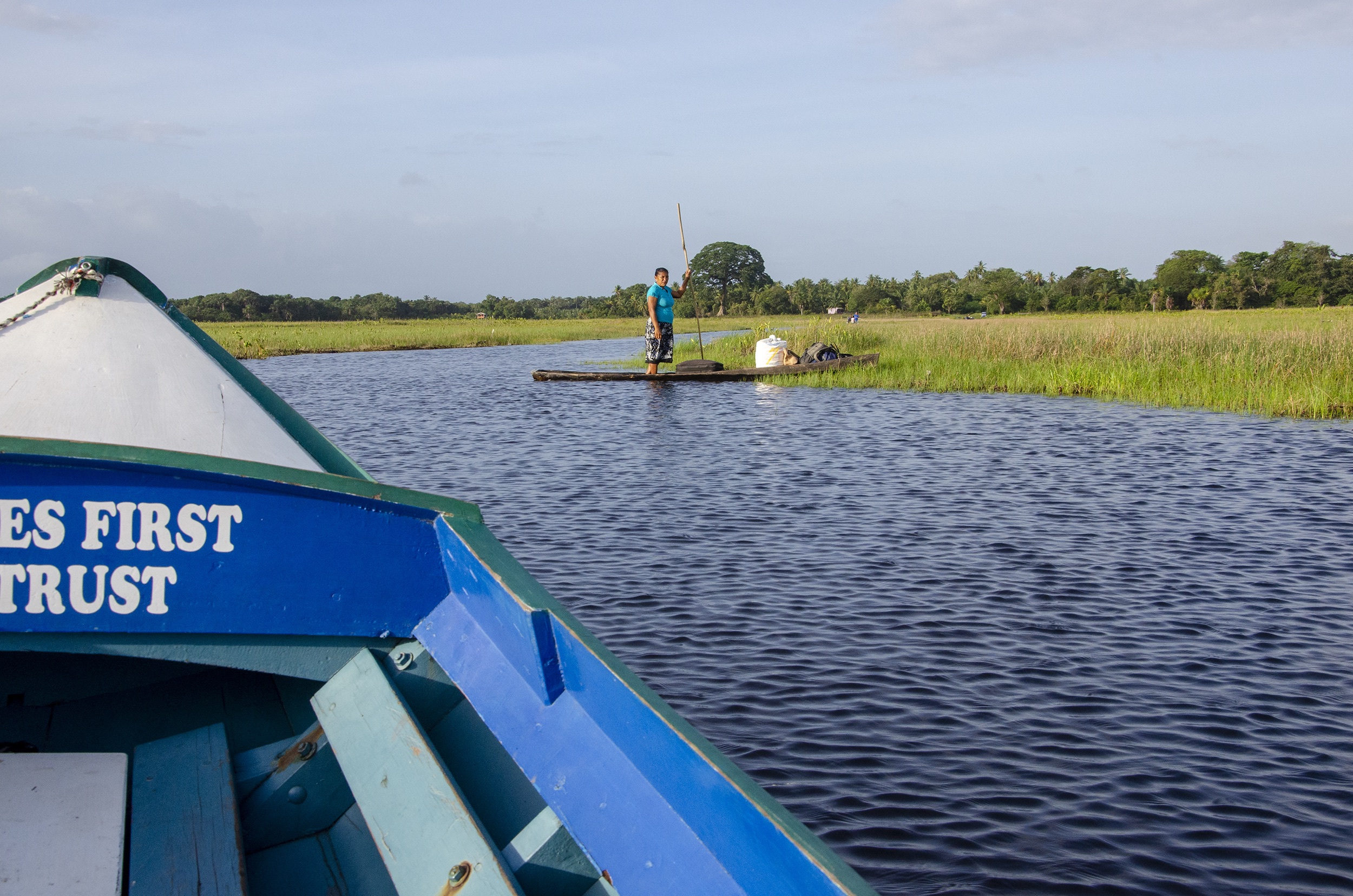
I was particularly interested in the future lives of women. Caribbean women activists and particularly the work of Red Thread became a starting point for evoking the relationship between Texas and Guyana – oil, ecological crises, wealth and company ownership, and what women were doing to lay bare the impacts of social injustices, racism, and inequality on their lived experiences. I wanted to create an artwork that could potentially reveal underlying historical traces, including the aftermath of colonialism and continued extraction from Global South countries such as Guyana, while creating an opportunity to envision alternatives.
Creating Like Gold Dust as montaged photographs, a sound installation and video provided the opportunity to visit Guyana in a state of change, with offshore drilling only the most recent chapter in a long history of extraction of the country’s resources. Like Gold Dust was created within a context in which corporate narratives predominate and fossil fuel companies and their financiers are keenly aware of the need to reinvest in alternative energy sources for the planet to survive the climate crisis. This work aimed to create, gather, and think alongside the individual and collective action of provocation and protest that contests the corporate narratives, compelling us to envision the environmental activist in order to imagine another future.
A series of provocations underpinned my research, interviews, and visits to make the work, including: How has such a ‘seismic changing’ project of finding fossil fuels started to have an impact in Guyana? How is this substantive discovery being captured in the media and popular imagination as it enters the history books? And, drawing the links between Houston and Georgetown, who were the past and present activists against oil extraction in Texas and Guyana? The findings of my research into historical and contemporary photographs, popular media, videos and reports associated with fossil fuel extraction, such as those found in archives in Texas, clearly established the patriarchal image of corporate life as evidence of modernism and societal advancement.
Take the 1922 photograph ‘Six men observing storage tank being filled with oil’ from the Bank of the Southwest Collection of Frank J. Schlueter at the Houston Public Library Digital Archives. Or picture the iconic film image of oil barons, portrayed, for example, on celluloid by John Wayne. Or imagine the smiling face of the Guyanese oil worker wearing a hard hat and overalls on a rig on the front cover of a company report.
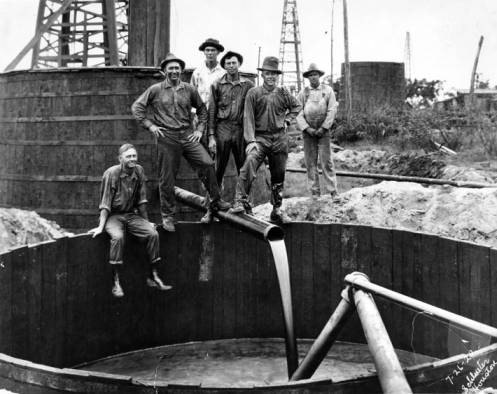
(Frank L. Schlueter/ Bank of the Southwest Collection)
Oil photographs such as these validate the necessity and significance of large-scale extraction of oil and gas as key to planetary progress, suggesting a ‘normative’ course of events of oil discovery, supply, and demand, whether in Texas, Mexico, or Guyana.
The overwhelming image of the impact of large-scale oil extraction these representations evoke is male-dominated, symbolic of a modern industrial state. These images are pictured as a contemporary story for the ‘benefit for all’, or as the ‘revised imagery’ of the company now mindful of the land, seas and other natural resources it is mining.
As a photographer, I continued to pursue questions in making the artwork: What does the environmental activist look like, and how might we visualise imagery that honours and connects their efforts? An example of the kinds of protests I learned of while in Texas was the resistance to the Trans-Pecos Pipeline, which went into service in 2017. The pipeline was built by Energy Transfer Partners to export U.S. natural gas over 148 miles from the Permian Basin in west Texas to Mexico. This is despite long campaigns by Indigenous and other local communities and supporters to protect the area’s natural resources and sacred land. Published photographs of the protesters are part of a normalising and familiar trope, selected for their newsworthiness and dramatic angles: most often women, standing behind long fabric banners and flags carrying slogans such as ‘defend the sacred’ or ‘keep it in the ground’, walking forward toward the camera collectively.
The phrase “gold dust” is associated with the preciousness of women as physical and symbolic embodiments of what is to come. I researched how else these women have evoked their own being, an approach informed by self-determined photographs representing the Native women-led IllumiNative organisation. Working with Latinx performance artists and activists living in San Antonio including Maria Alejandra Ibarra (1975–2021), founding member of the MadMedia/Reset Collective and cabaret artist, and Tejana actor, writer, and activist Amalia Ortiz to explore performativity and composure in the camera, I created staged photographs that aimed to capture the stoicism of the woman figure. These images are constructed, layered and montaged using combinations of historical and current landscape photographs from Guyana and Texas. The effect is the portrayal of a quiet form of confrontation that evokes the long histories of colonial violence enacted against the environment and majority women environmentalists.
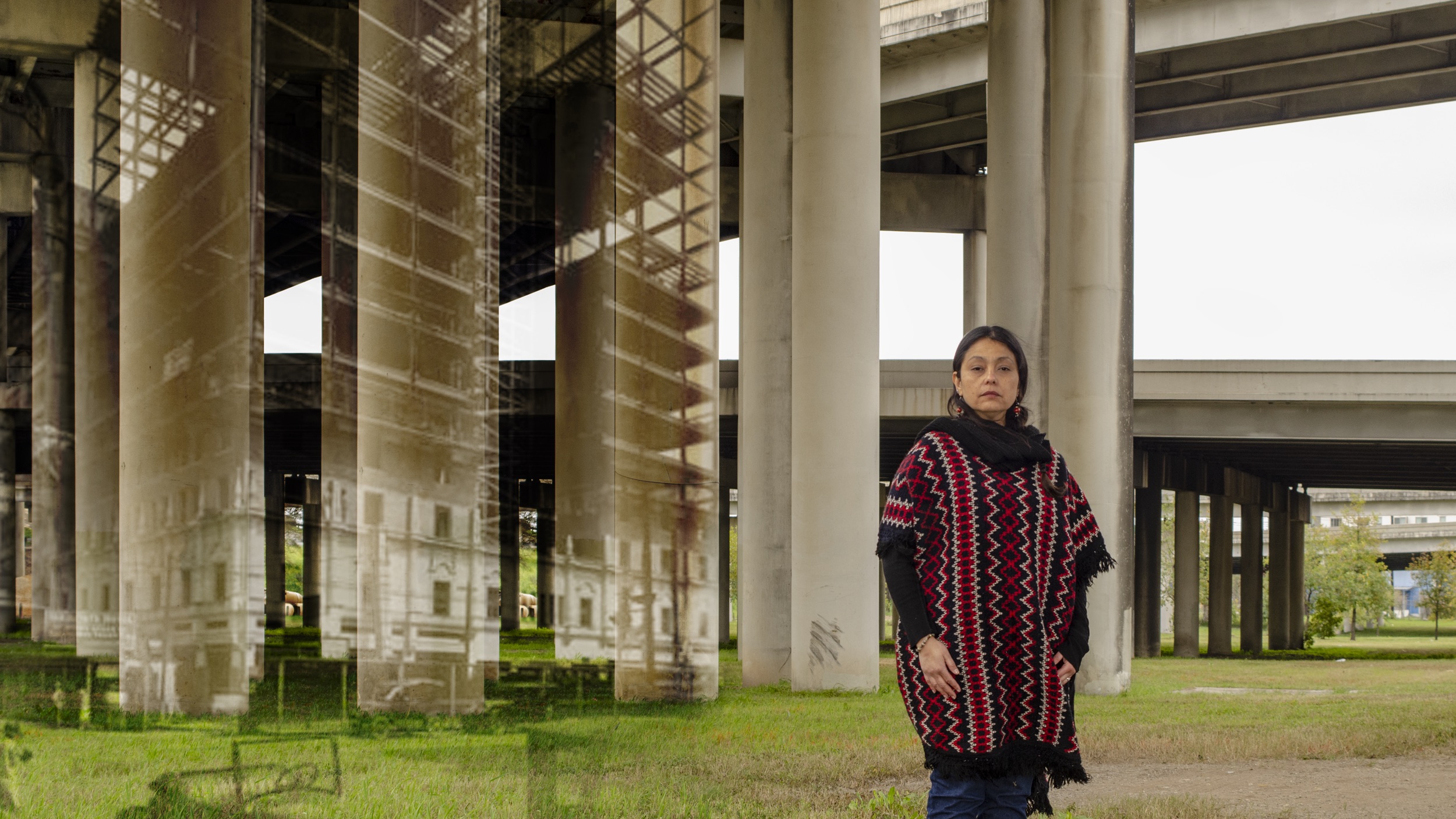
Migration, displacement, crossing borders and seeking a better future accompany colonial terrains and the ‘fever’ of finding resources such as Guyana’s recent ‘discoveries’ of offshore oil and gas. Words and chants spoken at campaigns and rallies, singing during marches and recitations of poetry all form languages of resistance, and are central to the slow, unwavering refusal captured in the images. Video documentaries such as extracts from Ghost Dance by Sara Littlecrow-Russell (2006) and poem-songs focused on the theme of revolution by Amalia Ortiz from The Canción Cannibal Cabaret & Other Songs (2019) inform the script and gallery text developed for Like Gold Dust.
Rather than reflecting on nihilistic questions, Like Gold Dust stays with women who want, demand, imagine and create a future beyond extractivism. Speculating through fictional writing and creating visuals as staged imagery, tracing lines of connection across Texas and Guyana, layering photographs and writing about imagined scenarios and possibilities are themes and processes that underpin the work and concept. Fabulation propels us into conceiving of a restorative post-capitalist practice in which care, protection from violence and the pursuit of social justice are prioritised. In the sound installation, a magical space is imagined, in which over half of the Guyanese Indigenous leaders or Toshaos are women environmentalists who network across continents and keep control of the botanical and medical knowledge of their plants.
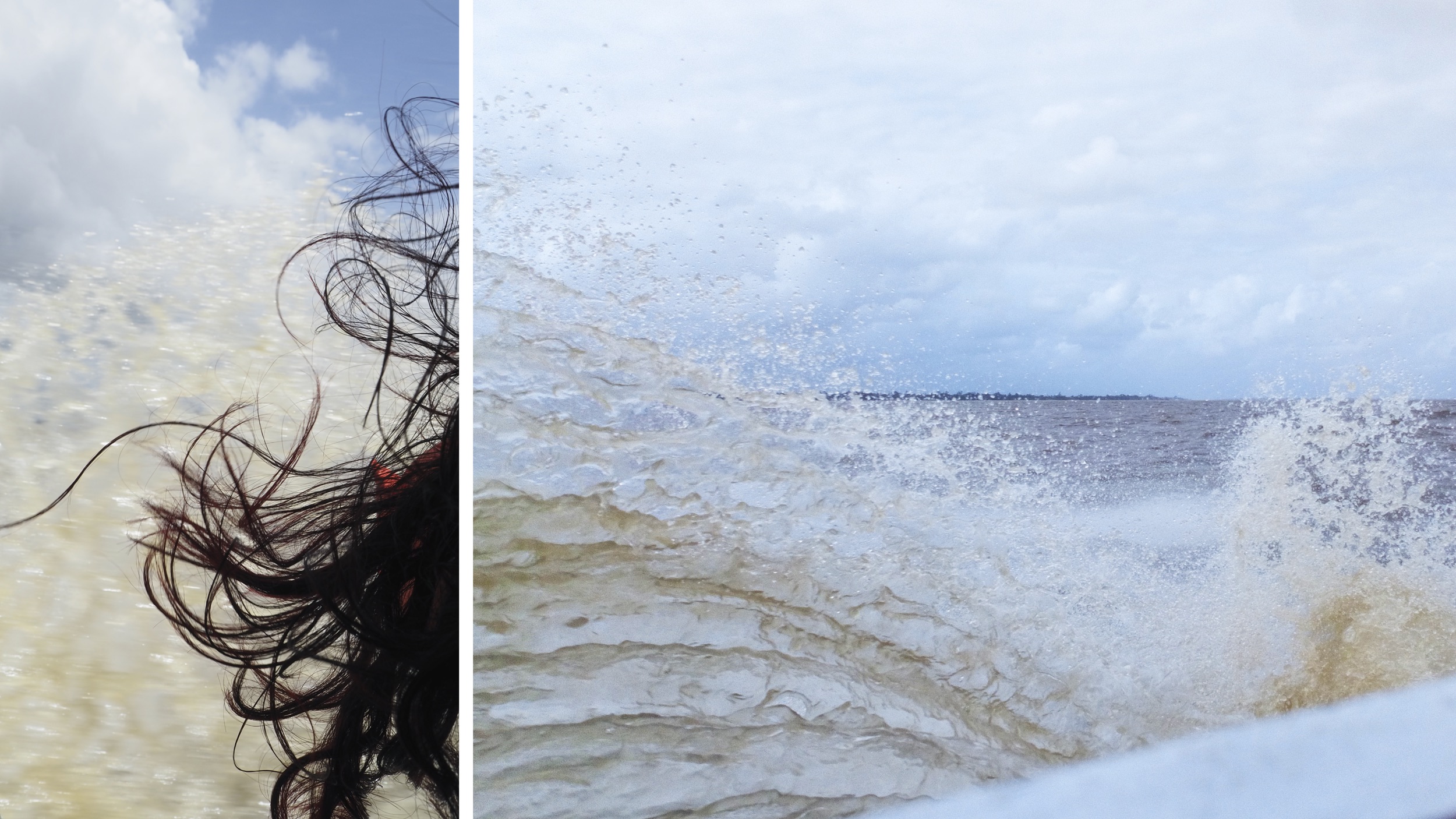
I reconfigure and imaginatively attribute gold dust to contemporary and future magical qualities of knowledge as survivors, as warriors, as keepers of forests, and carers of people and things across our connected landscapes. Inspired by the women activists who refuse to be silenced across these connected spaces, Like Gold Dust tracks the gaps in the promise of generalised abundance, offering an imaginative invitation to rethink the seemingly irreversible narrative of Oil Dorado.
Endnotes
[1] https://www.reuters.com/business/energy/exxon-led-group-earned-nearly-6-bln-guyana-last-year-2023-05-25
As a media artist, photographer and scholar, Roshini creates artworks that interpret and re-imagine experiences of the particular and everyday relating to historical legacies and memories by Caribbean persons and its diaspora. She evokes women’s perspectives, through photographs, fictional writings, recordings, music, interactivity and networked environments. Roshini’s current research and artistic practice explore audio-visual methodologies of Black, Indigenous and persons of colour in relation to Caribbean extraction, sustainability and ecological activism.
Current/recent exhibitions and scholarly work: Women in Revolt! Art and Activism in the UK 1970 – 1990, Tate Britain, London (8 November 2023 – 7 April 2024); Life Between Islands: Caribbean-British Art 1950s – Now, Tate Britain, London (2022); Fragments of Epic Memory, Art Gallery Ontario (AGO), Toronto (2021); Thirteen Ways of Looking, Herbert Art Gallery, Coventry, UK, (2020); Like Gold Dust, Artpace International Artist-in-Residence (IAIR), San Antonio (2019); Itinerant Imaginaries (2021), a seminar series convened by Creating Interference, an international research network investigating contemporary artworks as creative responses to memories and historical narratives; ‘Imagining Activism, Black, Gold, Dust’, Kunstlicht: The Worldliness of Oil, 42:3/4 (2021); a review of Deborah Cherry’s (2015) Passion, Maud Sulter for Aperture Photobook Review 018/Fall 2020; and the monograph Creole in the Archive: Imagery, Presence and Location of the Caribbean Figure, London: Rowman & Littlefield (2016).